How to generate a Japanese tattoo
Great irezumi prompts name three things: the main motif, the background elements, and the body area the design should flow across.
- Choose the hero motif — koi, dragon, phoenix (hou-ou), oni mask, cherry blossoms, or a combination.
- Add the background language: "stylized waves", "wind bars", "clouds and mist" — these are what make a design read as traditional Japanese.
- Mention the placement ("wrapping the forearm", "upper arm panel") so the composition flows with the body instead of sitting on it.
Japanese tattoo ideas to generate now
Classic irezumi directions with prompts tuned for the traditional look — bold outlines, limited palette, animated background.
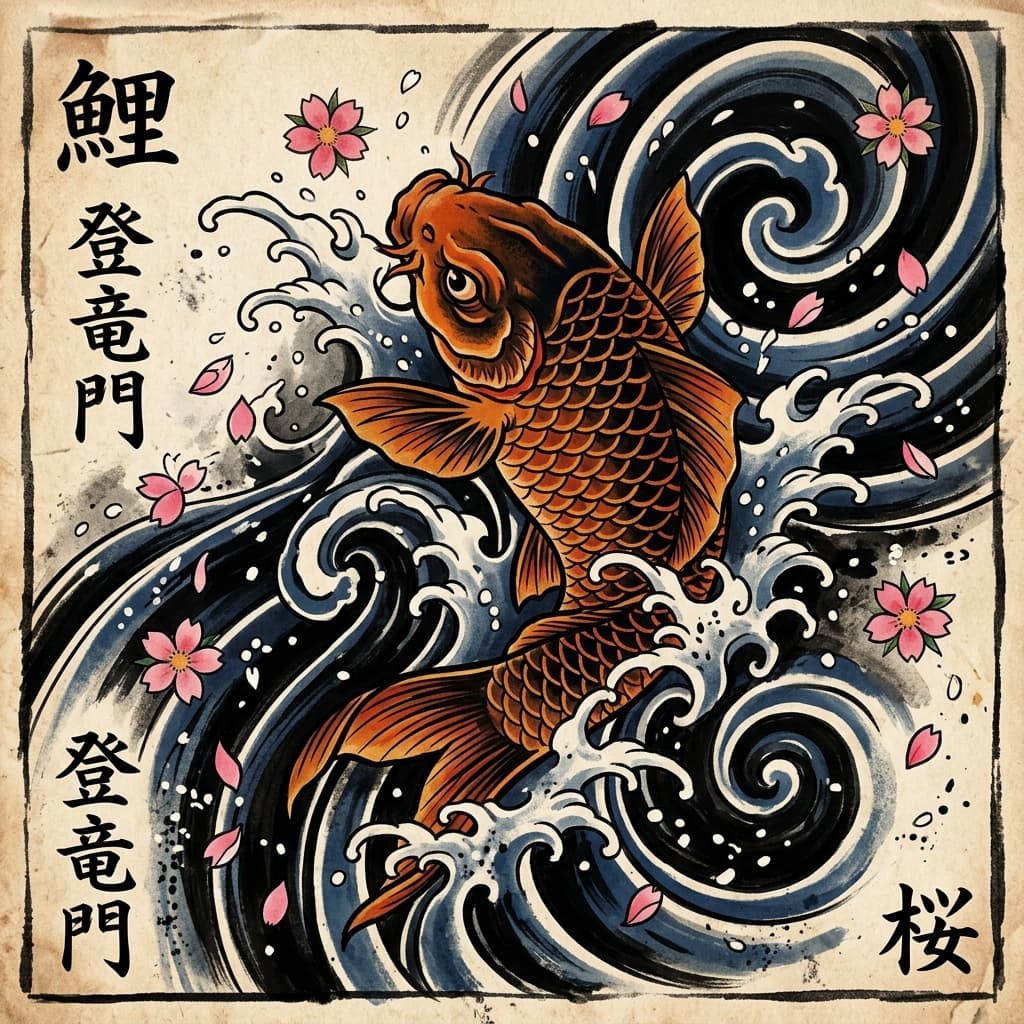
Koi leaping through waves
The koi is the icon of perseverance — traditionally shown mid-leap, fighting upstream, framed by turbulent water.
“Traditional Japanese Irezumi koi fish leaping through stylized dark waves with wind bars, bold outlines, limited palette”
Generate this idea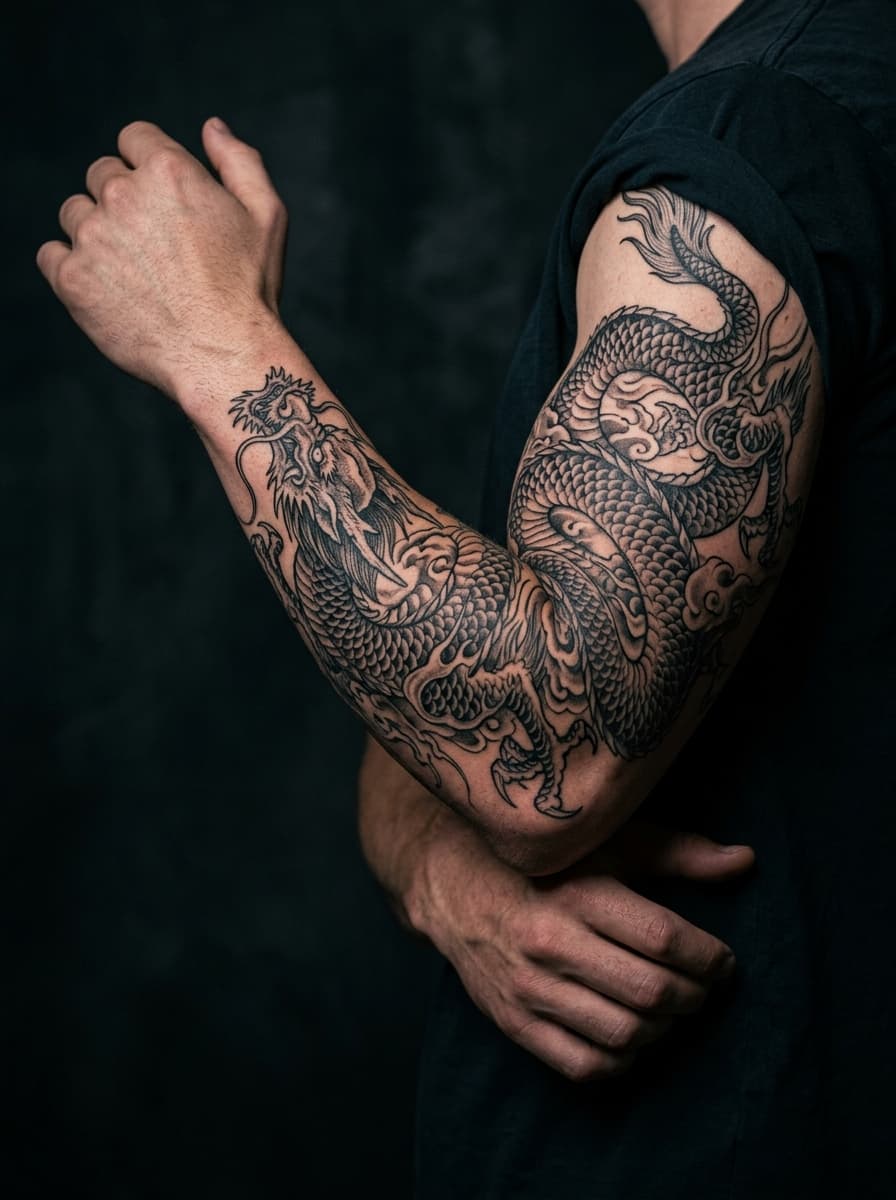
Japanese dragon
Irezumi dragons are drawn with three claws, camel-like heads and flowing whiskers — wisdom and protection in traditional reading.
“Traditional Japanese coiled dragon with flowing whiskers, tight scales, and billowing mist wrapping around the upper arm”
Generate this idea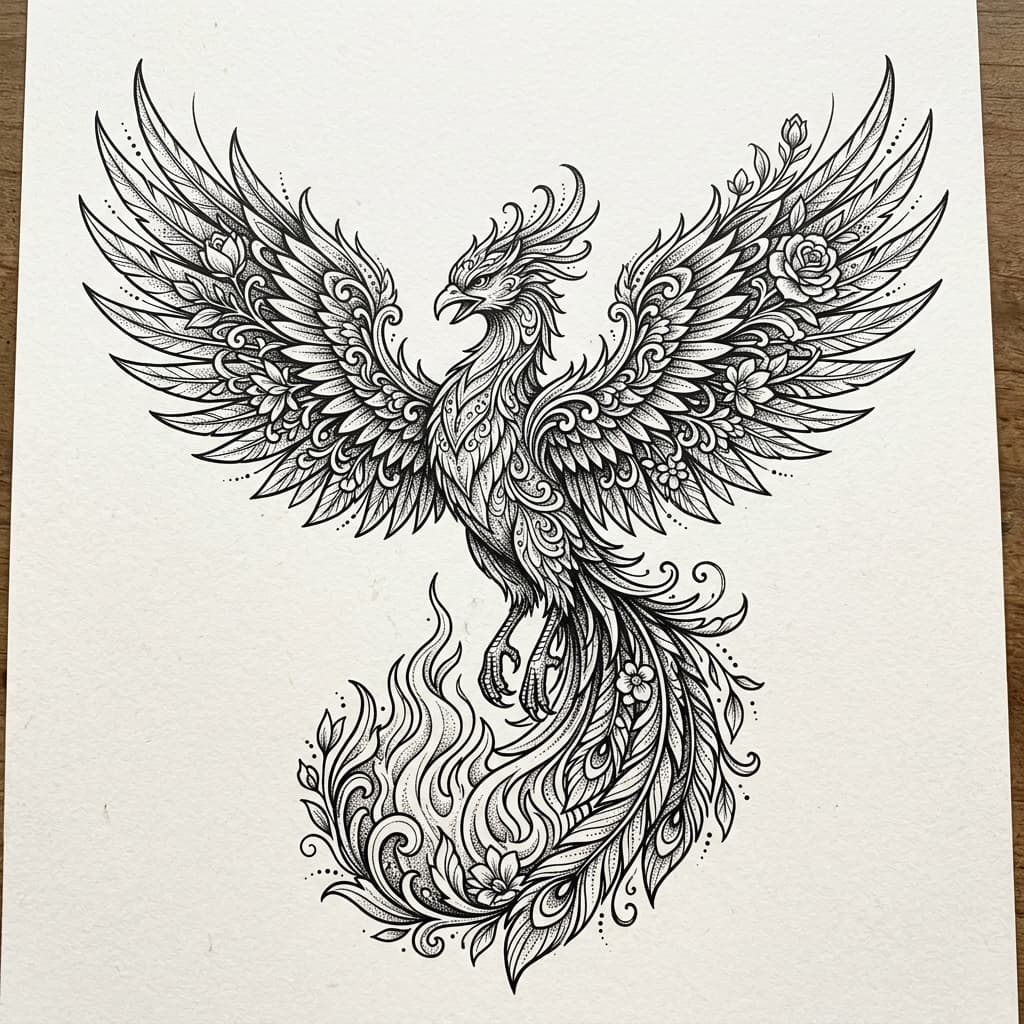
Phoenix — hou-ou
The hou-ou is the Japanese phoenix — rebirth and virtue — usually rendered with sweeping tail feathers among clouds.
“Japanese hou-ou phoenix with sweeping tail feathers among stylized clouds, traditional irezumi outlines and muted red-gold palette”
Generate this idea
Wave and wind bar background study
Waves, wind bars, and clouds are the connective tissue of irezumi — they carry a sleeve from motif to motif.
“Japanese irezumi background study of stylized seigaiha waves and wind bars in black and grey, designed to frame a larger motif”
Generate this idea
The core motifs and what they carry
Irezumi motifs come from woodblock printing and centuries of shared storytelling. Koi are commonly associated with perseverance and courage, dragons with wisdom and protection, cherry blossoms with the beauty of impermanence, and oni masks with guardianship against misfortune. Meanings vary by telling — treat them as tradition to reference, not rules to obey.
When you generate, naming two motifs plus a background creates a designed piece rather than a sticker: "oni mask with cherry blossoms falling over wind bars" gives the model a composition, not just a subject.
Irezumi composition: thinking in body flow
What separates traditional Japanese work from a single flash piece is composition across the body: panels that wrap limbs, motifs that curve with muscle, and backgrounds that connect everything into one surface. Sleeves, back panels, and chest-to-shoulder compositions are the classic formats.
You can test flow at idea stage by describing the body area in the prompt — "wrapping the forearm", "across the shoulder blade" — and checking whether the generated composition bends or just sits flat. Then take the winning layout to your artist, who will map it to your actual anatomy.
Traditional vs modern Japanese styles
Traditional irezumi uses bold outlines, a restrained palette, and full backgrounds. Modern takes — sometimes called neo-Japanese — keep the motifs but loosen the palette, mix in realism, or drop the background elements for standalone pieces.
Both work in the generator: "traditional irezumi" wording pulls the classic look, while "modern Japanese with realistic shading and no background" produces the contemporary variant. Compare a few of each before deciding what to bring to a studio.
Japanese tattoo FAQ
What makes a tattoo "traditional Japanese"?
+
Three things together: motifs from the irezumi tradition (koi, dragons, phoenix, oni, sakura), bold outlines with a restrained palette, and animated background elements — waves, wind bars, clouds — that connect the design. Without the background, a koi tattoo is a koi tattoo; with it, the design reads as irezumi.
What do koi and dragon tattoos mean?
+
In the tradition, koi are associated with perseverance (swimming upstream), dragons with wisdom and protection, cherry blossoms with life’s impermanence, and phoenixes with rebirth. Associations vary by story and region — choose motifs that speak to you, not just their dictionary entry.
Can I plan a full Japanese sleeve with this?
+
You can design the motifs and test compositions section by section — upper arm panel, forearm wrap, shoulder cap — then bring the set to your artist to unify on your body. See the sleeve tattoo generator for sleeve-scale planning.
Does it have to be black and grey?
+
No. Traditional irezumi uses color — deep reds, blues, greens, and yellows on black outlines. Your prompt controls it: name the palette for color pieces, or specify black and grey for monochrome work.
Are Japanese tattoos cultural appropriation?
+
Irezumi is a living art form with deep history in Japan, and attitudes vary. Many artists advise learning the meaning of the motifs you wear and choosing them with intention rather than as decoration. Reading the symbolism — and talking to your artist — is a good start.
Related tattoo generators and guides
Ready to design your Japanese tattoo?
Pick a motif, add waves or wind bars, and generate traditional irezumi concepts free — no sign-up.
Open the Japanese tattoo generator